Code structure / infrastructure plans
Core tools
- Use Python (as ambulance team are familiar).
- Use uv for environment management, as it handles Python versions and dependencies, with a simple configuration and a lock file.
- Use SimPy for DES (as it is popular, taught on HSMA, and also should be familiar).
- Use sim-tools for distributions
- Use vidigi for animation
To discuss:
- What is preferred for environment management? Would uv be ok?
Open and private workflow
- Structure the model code as a public Python package.
- Make the model documentation public.
- Use dummy data in the public repository for examples.
- Design the public package so it can be imported and run privately on local data. Ensure the public version reproduces all key analytical steps.
To discuss:
- How does this sound? What is sensitivity of aggregate parameters?
Documentation
Use Quarto on GitHub pages for a single documentation site including the project specification, code documentation via quartodoc, and examples run on dummy data. This will include:
- User documentation explaining how to run and interpret the model
- Technical documentation explaining the model structure and implementation
- An ongoing record of data sources, assumptions, inputs, and decisions - including any changes to the analytical plan or decisions made during analysis
- STRESS-DES items
- Documentation requirements from the PyOpenSci checklist
Also maintain the following repository documentation:
README.md(see here for contents)CONTRIBUTING.md(see here for contents)CHANGELOG.md- doing releases and archiving to ZenodoLICENSECITATION.cff
Citation as per https://pythonhealthdatascience.github.io/des_rap_book/pages/guide/sharing/citation.html
Code design
Use an object-oriented design.
Have a logging system in place which can enable/disable. Shouldn’t slow it down too much! Be wary of that. Ensure address things raised in NHS model reuse interviews e.g. broad logging messages as run.
Once run times get longer, use parallel processing.
Provide a single-command mechanism to run everything end to end.
Will require some thought around how best to design modular components that can be easily swapped or extended. Some duplication will be inevitable, so the aim should be to minimise it with a clear and maintainable structure. Something like:
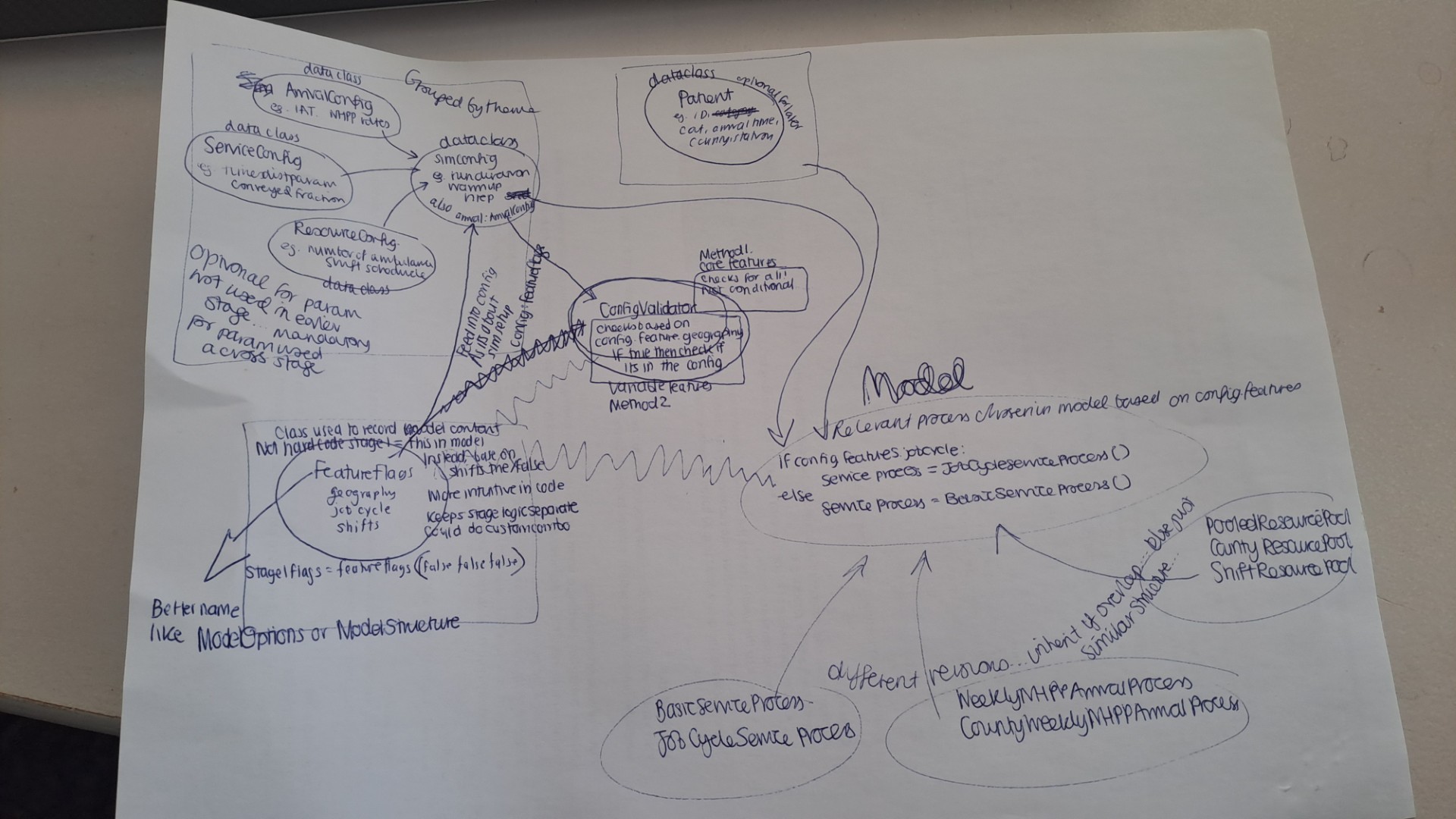
Also, review whether current scenario approach could be improved, as can feel a little clunky.
Consider how could improve speed… monitor speed as build - identify what slows it down
@dataclass
class SimConfig:
    warm_up_duration: int
    results_collection_duration: int
    n_replications: int


@dataclass(frozen=True, kw_only=True)
class ModelStructure:
    geography: Literal["none", "county", "lsoa"]
    arrivals: Literal["overall", "daily"]


from dataclasses import dataclass
from typing import TypeAlias

import pandas as pd


@dataclass(frozen=True)
class CategoryArrivals:
    """Arrivals by response category."""

    data: pd.DataFrame


@dataclass(frozen=True)
class DailyCategoryArrivals:
    """Arrivals by response category and day of week."""

    data: pd.DataFrame


@dataclass(frozen=True)
class CountyDailyCategoryArrivals:
    """Arrivals by response category, day of week and county."""

    data: pd.DataFrame


# These can all be referred to as "Arrivals" type
Arrivals: TypeAlias = (
    CategoryArrivals
    | DailyCategoryArrivals
    | CountyDailyCategoryArrivals
)
Inputs
Possible input formats:
- Excel workbook - proprietary but standard
- CSV
- JSON - not well liked in NHS model reuse interviews
Quality and style
- Use type hints.
- Use NumPy-style docstrings.
- Use ruff for linting.
- Use lintquarto for linting the quarto site, and the image alt-text linter action.
- Include a linting CI/CD GitHub action.
Testing
- Write tests with pytest.
- Run tests through CI/CD.
- Include a test coverage action.
- Arrange tests by theme, then use pytest markers for test type. se language from our training to describe them.
- Include a smoke test as a gate.
Version control
- Use
devandmain.